
By Clifford C. Dacso, MD, MPH
Chief Clinical Officer, Knox Clinic
September 20, 2026
On July 4, 2025, President Trump signed into law the One Big Beautiful Bill Act, a broad and multi-faceted piece of legislation. One very prominent feature has been sweeping changes to Medicaid that will culminate in January, 2027, three months from now.
Some history: Medicaid (MaineCare) has been around since 1965. It was passed as a companion to Medicare and designed to cover health care for low income and elderly disabled people. Gradually, over the years, its scope expanded, most dramatically in 2010 with the passage of the Affordable Care Act (“Obamacare.”) This expansion allowed the individual states to provide coverage to a larger number of adults with substantial contribution from the Federal government. Maine elected to expand, extending MaineCare to tens of thousands more Mainers.
So, how do changes in Federal programs affect our neighbors today? 23% of Mainers receive MaineCare full benefits; over 4% get their health care through the Marketplace of the Affordable Care Act. Beyond these two public programs, most Mainers get coverage through an employer or Medicare though an estimated 85,000 Mainers have no coverage at all. And close to 80% of those people have at least one full-time employed person in the family.
The implications are dramatic for the health of our community. When payment for health care becomes a major issue, people delay care, and thus they show up in crisis at hospitals and already financially strapped. Through hospital care, they then accumulate debt. A little less than one third of Mainers report medical debt in excess of $5000, and about 15% of our neighbors are in debt collection proceedings. Remember that the overwhelming majority of these people, our neighbors, are working people. They are farmers, merchants, fishermen, and disabled people, for whom medical costs are an unconquerable mountain.
The One Big Beautiful Bill Act’s changes to Medicaid are designed to make it harder for people to get coverage, and harder to keep it.
Community Health Centers like the Knox Clinic sit at the intersection of the entire problem. As a Federally Qualified Health Center Look-Alike, the Knox Clinic has the obligation to care for everyone, regardless of ability to pay. More than that, it is our mission, our reason for being.
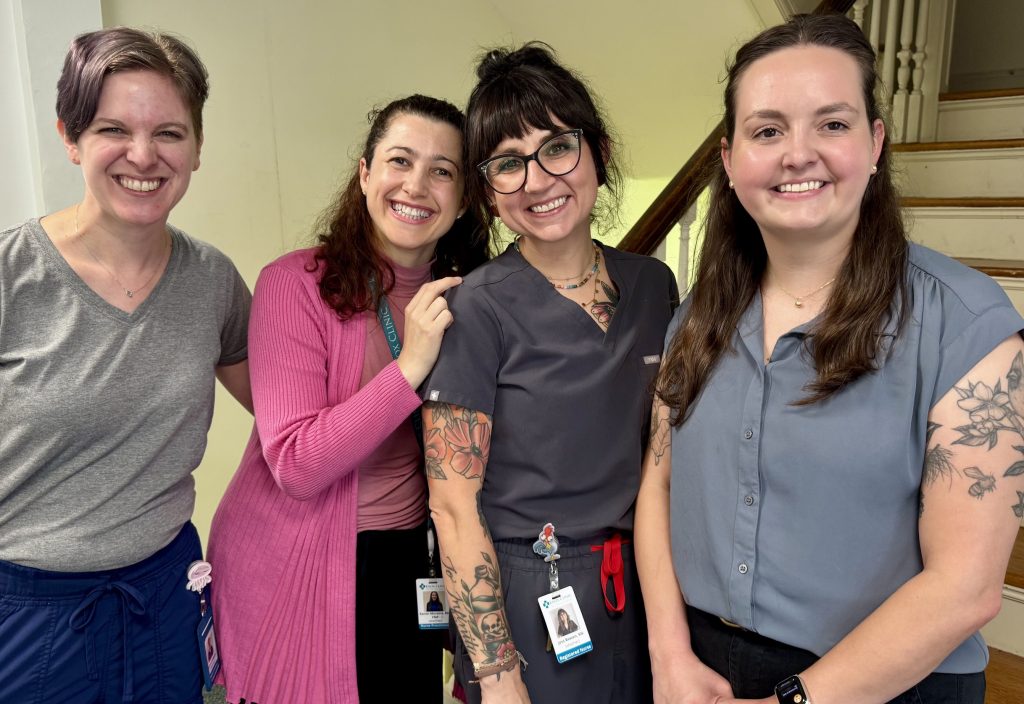
A few of our Knox Clinic team members, left to right: Medical Assistant Brielle DeMaria; Karen Moreira, RN, FNP; Jess Bowen, RN; and our new, incoming Family Physician, Dr. Erin Metzer.
We are preparing for the eventuality of lowered revenues and increased demand for our medical, dental, and behavioral health services by a combination of strategies.
- First, we have done amazing things to our venerable Bok Building, our home for the past two years. As I write, we are weeks away from moving our dental practice from its long-time home in Rockport to the second floor of our Rockland building. The new dental space is equipped for 21st century dentistry.
- Second, we have revamped our heating and cooling system for maximum efficiency. No longer will we be pouring heat into the surrounding atmosphere on those frosty winter days.
- Third, we are growing our team and our services with intention. We have recruited a family physician to join our internal medicine doctor, family nurse practitioner, and pediatric nurse practitioner. Mental health services are provided regularly. We are gearing up to provide mobile health services in our medical bus, and community coordination is provided by an access navigator.
Far from cutting back, the Knox Clinic is embracing the coming challenges and will continue to be present for our community, the community we have served for 26 years. The coming years will be difficult. All medical organizations in Maine are under stress. As a federally qualified health center, we are metaphorically at the tip of the spear. We depend on our dedicated and superbly competent clinicians, nurses, staff, friends and donors. Together we will weather the storm and prevail.
–
RELATED STORY: Where Medicaid cuts could hit hardest in Maine // Maine Monitor, September 9, 2026